

Mortal Shell II was released on August 20 and almost immediately received what the first part was noticeably lacking: the feeling that the developers were no longer saving on scale.
The original Mortal Shell was fun, but small and too slow in places.The sequel became larger, faster and noticeably more confident.
Cold Symmetry retained the grim world, shell system, and heavy hitting, but rebuilt almost the entire game around them.And the strangest decision turned out to be one of the best: the stamina scale was removed from the combat system altogether.
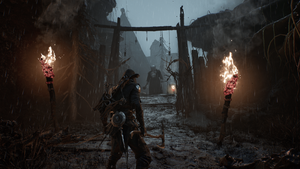
Without stamina, but not thoughtlessly
In most soulslikes, stamina determines the pace of combat.He made several hits, dodged and retreated until the scale was restored.
Mortal Shell II does not have this limitation.You can attack and dodge as much as the situation allows.Because of this, the battles became more aggressive and faster than in the first part.
But the game doesn't turn into a regular slasher.The animation of a started strike cannot simply be canceled, so a heavy swing still needs to be calculated.
GameSpot calls the elimination of stamina one of the main improvements to the sequel.At the same time, the blows have not lost weight: the weapon still feels heavy, and mistakes are still expensive.
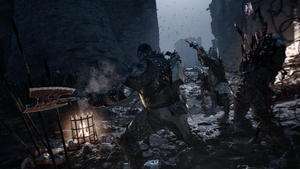
Resolve appears instead of stamina
Freedom of attack does not mean that there are no more resources in battle.It’s just that now the main resource is called Resolve.
It fills when the player successfully makes a melee attack.You can spend Resolve on special shell abilities and additional weapons.
This is where the interesting rhythm comes in.To use strong techniques, you have to go forward and fight, and not circle around the enemy waiting for the right moment.
The additional weapon also turned out to be much more interesting than the usual “bow just in case.”There's a shotgun, a miniature machine gun, and even a lute that forces enemies to attack each other.
Shells now really change the way you play
The main idea of the first Mortal Shell has not disappeared anywhere.We play as a weak Harbinger, who can inhabit the bodies of dead warriors - Shells.
There are eight such shells in the continuation.Each has its own characteristics and abilities, so the choice now has a noticeably stronger impact on the style of play.
Eredrim is suited for aggressive melee combat and can shoulder-ram into opponents.Tiel plays faster, uses invisibility, and benefits from accurate dodges.
Sariel is built around the unusual mechanics of Pain, where part of the damage received is converted into a separate resource.It's no longer just a choice between a "fast" and a "fat" character.
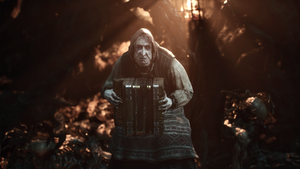
Harden is still working - and that's good.
Harden was the best find of the first part, so it would be strange to remove him.The player can turn the shell into stone for a short time and take the hit without taking damage.
It's especially nice that Harden can be used directly during your own attack.He began a heavy swing, saw an oncoming blow, became petrified, accepted the attack and finished the movement.
But now Harden is not the only way to protect.The new Seals allow you to choose a more familiar block or parry, so continuing to force less of one playstyle.
There is an open world, but it's not Elden Ring
Mortal Shell II became a game with an interconnected open world.There are no huge empty fields tens of minutes away.
The locations are more reminiscent of individual levels from a linear game, connected by several routes.Castles, swamps, caves and villages are densely filled with enemies, secrets and workarounds.
GameSpot praises the density of the world.Exploration regularly rewards you with new items, weapons, shells, or simply unusual places.
PCGamesN evaluates this element more strictly and criticizes the navigation.The world is big, the routes are confusing, and the ease of movement does not always correspond to the scale.
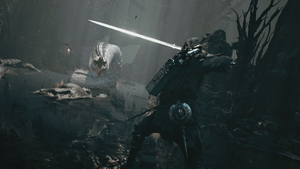
There is also a simpler problem - cliffs.The map literally hangs over the abysses, and many attacks throw the character back.
As a result, sometimes it is not the enemy himself who is more dangerous, but the edge of the platform behind him.GameSpot specifically lists frequent crashes as one of the level design flaws.
Bosses are not always good
Mortal Shell II has a wide variety of enemies.Knights, fanatics, assassins, insect-like creatures and stranger creatures are forced to react differently to attacks.
But with bosses everything is less smooth.Some mini-bosses are too predictable, and the standard parry window is sometimes so generous that a serious opponent turns into an exercise in repeating the same timing.
The balance of assemblies can also break down.Some combinations of skins, weapons and upgrades give too much of an advantage.
On the other hand, the very opportunity to put together a truly different build is one of the main advantages of the game.Mortal Shell II constantly encourages experimentation, even if its economy sometimes gets in the way.
There is even an almost official “easy mode”
This is unusual for the genre.In Mortal Shell II you can equip the Slayer Seal, which makes it much easier to complete.
The solution has a price: achievements and trophies are disabled with an active item.This is not an ordinary difficulty switch in the menu, but part of the game system.
For those who found the first Mortal Shell too harsh, this could be an important change.At the same time, the main mode remains demanding.
Visually the game has become much richer
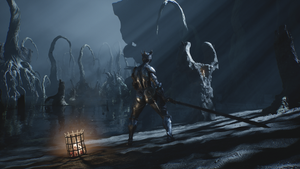
The dark fantasy here is still mixed with something almost cosmic and unpleasantly physical.Huge teeth in cave walls, strange cultists, monolithic structures and grotesque creatures constantly disrupt the usual image of medieval fantasy.
At the same time, the game knows how to be beautiful.Gray monasteries are diluted with red foliage, dark ruins are illuminated by torches, and certain spaces almost completely lose color.
Mortal Shell II doesn't try to blend into FromSoftware's aesthetic.She still has her own face, and in the sequel it became more noticeable.
Not everything could be fixed
The main problem with the continuation is that ambitions have grown faster than the accuracy of individual systems.Critics complain about the camera, navigation, falls from heights and uneven balance.
There are also restrictions on upgrading weapons.GameSpot notes that there isn't enough money to safely max out a few of the main weapons.
This is strange for a game that also actively encourages experimentation.Changing your weapon of choice late can be costly.
On PC, user reviews on Steam are in the category Mostly Positive.At the time of writing, about 79% of English-language reviews were positive.
This is no longer “little Dark Souls”
This is how Mortal Shell was often perceived in 2020: a compact and unusual variation on the theme of Dark Souls.The second part moved noticeably further from this definition.
The lack of stamina, Resolve, eight shells, Seals, weird ranged weapons, and dense open world give it its own structure.It still owes a lot to FromSoftware, but that's no longer the only thing I want to say about the game.
Press reviews confirm this.Mortal Shell II is currently on Metacritic 84 points out of 100.GameSpot gave the game an 8/10, GamesRadar+ an 8/10, and PCGamesN a 7/10.
This is not a new Elden Ring and not an undisputed masterpiece of the genre.But the sequel was clearly much stronger than the first part.
Is Mortal Shell II worth playing?
If the original Mortal Shell was enjoyable for its atmosphere and Harden system, a sequel seems almost a must.Cold Symmetry kept the main ideas and gave them much more space.
If you didn't like the first part because of its slow combat and small scale, Mortal Shell II is also worth giving a chance.These are the elements that have changed the most.
And for those expecting a perfect Elden Ring-level open world and flawless FromSoftware bosses, it's best to lower your expectations a little.The sequel is still rough.
Mortal Shell II no longer seems like a good idea for a small game.Now this is an independent soulslike, which no longer has to justify itself by the size of the studio.
Mortal Shell II was released on August 20, 2026 on PC, PlayStation 5 and Xbox Series X|S.
What do you think of this approach to soulslike: is endurance really needed by the genre, or do battles only get better without it?
SNBK Games
News • Reviews • Retro
Sign in or create an account to leave a comment.
Be the first to share your thoughts.